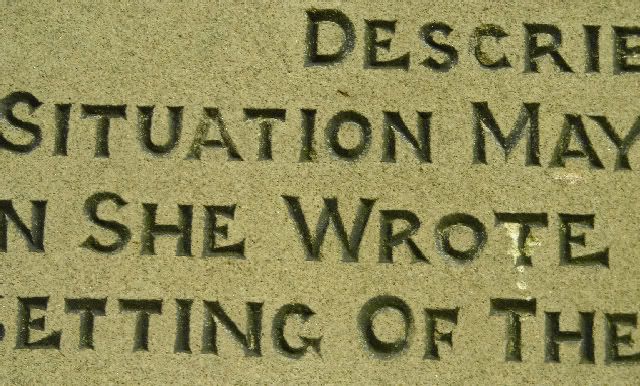
1930
Black minds. A municipal undertaking
Work Progress Administration it widen
Sick White Magic. Engraved, segregated.
Second Ward (a) Negro Elementary
Also grab it known as "annex". Invasion.
Lady Eleanor she show up she herself
Dedicate the Segregated surgery
On the 1925 dilapidate
Dilate the pupils
"New Deal"
White Avenue
*
"Everyone looks the same in a coal mine."
Utopian impulse, intentions bested by accretion
Of time. The same old new deal,
"other half" and have-nots.
Can't tell slavery slant.
*
A poetic sequence alongside a series of black and white photographs taken by the author, a poetry and investigation of place and surely what also makes the young poet. Excerpted here is the first poem in a series of 12. 'Can't tell slavery slant' seems a direct echo/response to Dickinson, where there is no room or time-notwithstanding for seeing slant, but only as what it is. This restrospective does this, illuminating a small town, in the wider scope of so many small town America's, and the change of/in the post-segregated south, and its inhabitants and the suprising ability to produce music or the music of and in the line in such places for those of us who are so searching.
Here is the poem which places the title, HOW MANY OF YOU ARE YOU?:
Bats
How many of you are you?
I told you, you should see where I was sitting
To see the show.
This is it, sunlit, straps, nest, and bottle.
Apocryphal window,
But oh it certainly is true.
"And Also You" watches the Power Plant
Consumes poison for the venom of dawn.
Protect Nature charged with ions
Enfolds with flood of bats.
I left some food for you to share
In a white container to the far right.
Encircle and become left.
There's a mattress to crash on too,
Blotted with sun and one question:
How many of you are you?
And, How Old Is It? takes to task the presumed witnessing of an old tree, and where reverberations are still felt over a 100 years later, where, 'the/ Tree surrounded. Stuck condition. Civil War is/ Circular looking glass, it's made of guns and/ Cash and of industry. The ground it soaks the blood and does not care. An energy that/ Is itself, unconditional condition

This is an interesting series which also includes other text in way of a letter detailing a strange and compelling dream of a Captain William Porter Wilkin of the West Virginia Cavalry written in 1863, to his wife presumably still on the other side of the water.
The pictures throughout, all seem bleak and wanting, do add in this way to the whole piece and this is also where the young poet comes in, turning ordinary experiences and daily secretings in such places from the realm questioning and inquiry toward the philisophical, one small town becomes so many small towns, where 'Confectionary keystone/ is epicenter, is more'